
WASH+
Exploring how neighbours could coordinate mobile car washes while reducing travel for detailers.
OVERVIEW
Wash+ began as a marketplace for booking trusted mobile detailers. Competitor research showed that this proposition was already widely offered, while individual bookings remained expensive for drivers and inefficient for detailers travelling between jobs.
I evolved the concept around neighbourhood Wash Days, allowing nearby residents to book within one local service round at a lower rate than an individual mobile booking. Detailers could review access, travel distance and expected revenue before accepting multiple jobs in the area.
PLEASE NOTE, THIS PROJECT IS:
Self-initiated, hypothesis-led product concept based on competitor research and publicly available industry evidence. The proposition has not yet been validated with drivers or detailers.
My Role
Product Designer
PROJECT TYPE
Self-initiated
Product Concept
Making mobile detailing easier to find and book
Wash+ originally helped car enthusiasts find, compare and book trusted mobile detailers at a convenient location and time, but offered little differentiation from existing services.

Image: The original marketplace journey focused on finding, comparing and booking individual detailers.
The original proposition had become the category standard
I reviewed leading mobile car-care services to understand what users already expected and where Wash+ could create more meaningful value.

I reviewed publicly available product information, service policies and customer-facing features across six mobile car-care services.
KEY FINDING
Booking features had become standard, but no competitor centred its consumer experience on coordinating multiple nearby drivers into one local service round.
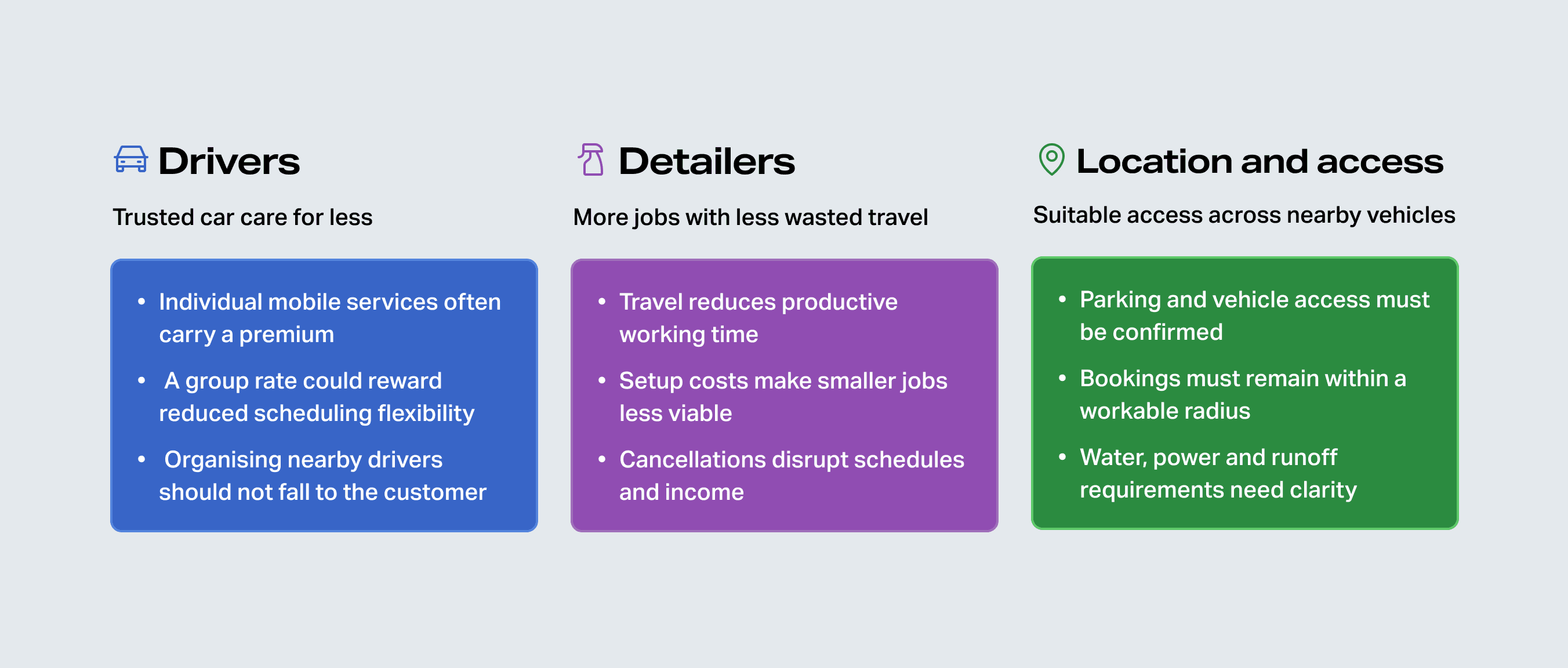
Neighbourhood Wash Days needed to work for drivers, detailers and locations
I combined patterns from competitor reviews, service policies and public detailer discussions with the operational risks introduced by clustered bookings.
KEY FINDING
Wash+ needed to turn reduced travel into a better price for drivers without making them coordinate neighbours or asking detailers to accept an unviable route.
Clustering nearby bookings could lower costs and improve route value
Drivers paid a premium for mobile convenience, while travel reduced productive time for detailers. Clustering nearby bookings could support a lower group rate while making each local route more worthwhile.
HOW MIGHT WE
How might Wash+ make mobile car care more affordable for drivers while making each trip more worthwhile for detailers?

The proposed group rate depends on reduced travel and setup time making the overall route commercially worthwhile for the detailer.
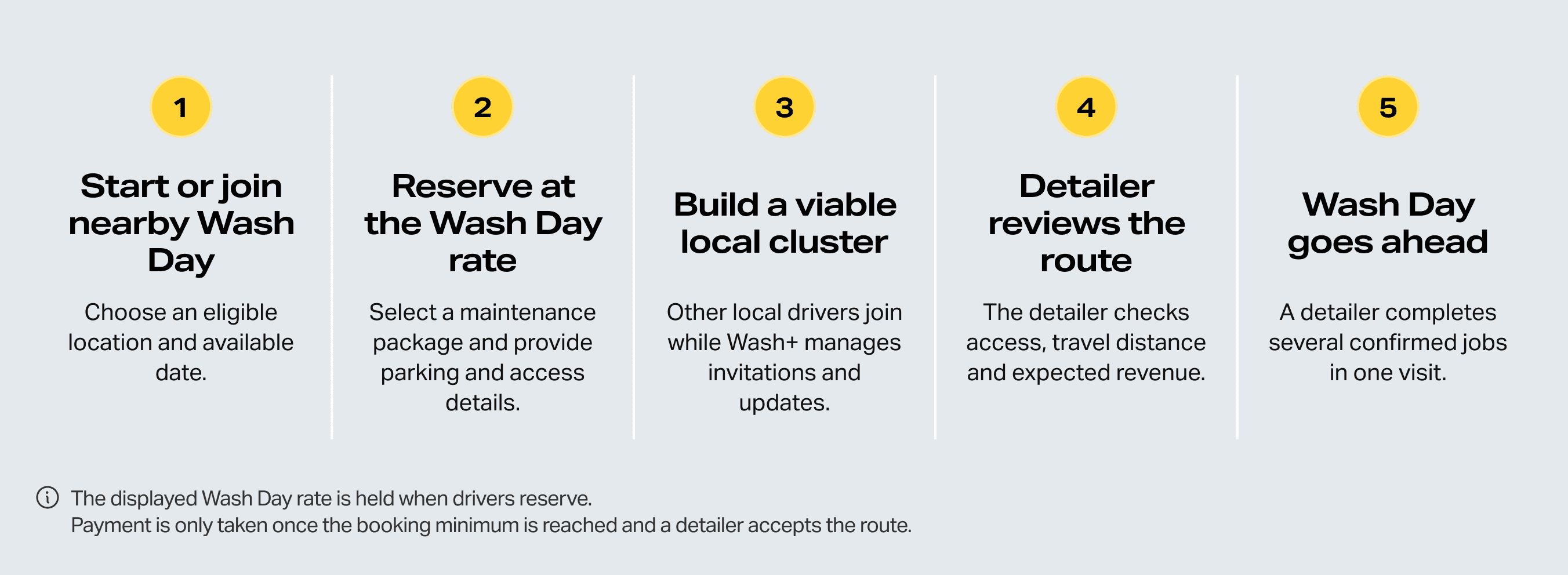
Neighbourhood car care, organised around where drivers already park
Drivers start or join a nearby Wash Day and reserve a discounted maintenance service at their home location. Once the booking minimum is reached, a detailer reviews the local route before accepting.
Three assumptions shaped the MVP
Before designing the new experience, I identified what needed to be true for neighbourhood Wash Days to work.

KEY FINDING
These assumptions focused the MVP on coordinating a viable neighbourhood Wash Day, not rebuilding the detailing marketplace.
Turning the hypothesis into a focused MVP
I prioritised the minimum experience needed to communicate the value exchange, assess each booking and coordinate a viable neighbourhood Wash Day.
Included in the MVP
Start or Join a Wash Day
Compare individual and Wash Day pricing
Add parking and access details
Reserve a place
Track Wash Day progress
Receive confirmation and a service window
Manage the booking
Considered later
On-demand bookings
Loyalty and referrals
Specialist services
Detailer tools
Recurring plans
Mapping the core journey: how drivers start or join a neighbourhood Wash Day
I designed two routes into the same local service, with confirmation dependent on sufficient demand and detailer acceptance.

Making a conditional booking feel simple
The experience needed to help drivers reserve with confidence while Wash+ coordinated nearby demand, access and detailer acceptance behind the scenes.

Refining the moments that shaped trust and viability
Reviewing the end-to-end journey revealed three areas requiring greater clarity: the value of the Wash Day rate, the path to confirmation and the information detailers needed to assess each stop.

Pricing clarity
I introduced comparable individual and Wash Day rates so drivers could understand the saving before reserving.

Confirmation clarity
I separated the booking conditions into sequential milestones so drivers could see what was complete and what remained pending.

Access clarity
I replaced broad text fields with structured inputs so detailers could assess the feasibility of each stop more consistently.
The final Wash Day experience
The final interface helps drivers join a nearby Wash Day, provide the information needed to assess their booking and understand what happens before the service is confirmed.

A stronger proposition with key assumptions to validate
Wash Days created a clearer value exchange between drivers and detailers, but the proposition still depends on assumptions that would need testing before development.
What I learned
Convenience was not enough
Reduced travel created a stronger shared value proposition for drivers and detailers.
Reduced flexibility needed a clear reward
The Wash Day saving had to justify conditional booking and approximate timing.
Detailer viability shaped the experience
Route value, parking and access determined whether a reservation could be confirmed.
What I would validate next
What saving changes behaviour?
Test the discount required for drivers to accept less flexibility and conditional confirmation.
What makes a route viable?
Test the combination of booking value, distance and service duration required by detailers.
How long will drivers wait?